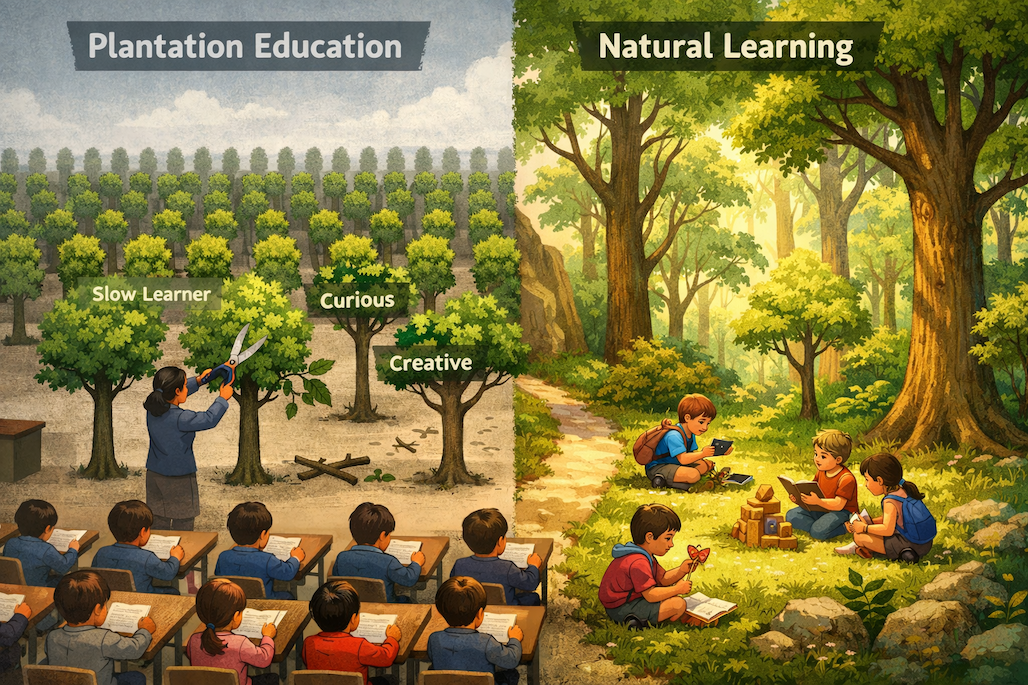
In many countries, the current education system requires a child to be sent to a school where they sit in a classroom with 50 or more peers.The setup is
One teacher to many students
Fixed curricula and schedules
Emphasis on exams, memorization, and compliance
Success measured mainly by test scores and certificates
While this model seems to work efficiently, it is seriously sub-optimal and a very lazy solution at best. It is reasonably efficient at producing uniform skills and managing young populations as they grow. The current education model treats learners just like trees in a plantation, not a forest. The deliverables of the current education system are kind of:
“By age 10, every tree must be exactly 2 meters tall and perfectly straight.”
So the system basically:
Trims taller trees (discouraging excellence or curiosity)
Forces weaker trees to stretch unnaturally
Cuts off branches that don’t fit the template
The result?
Uniform appearance
Weaker trees
Lost potential
In this setup, the schools are “trimming” grounds for learners. Those who learn fast are told to wait, slow learners are labeled weak (some expelled), the curious and questioning ones are seen as disruptive, the creative and practical ones are marginalized while different learning styles are forced into one method.
I think the world must look for more optimal solution to educating children. No wonder many adults describe their school experience as routine rather than a transformative growth opportunity that shaped their current lives.
For generations, education has largely positioned the learner as a passive receptor of information: listen carefully, take notes, memorize, reproduce. This model has produced capable graduates, but it has also left many learners behind—especially those whose pace, background, or learning style does not align with the “average student” the system quietly assumes.
Adaptive learning systems challenge this assumption at its core.
At their best, adaptive learning systems endeavor to transform the learner from a passive receptor of information into an active collaborator in the educational process. This shift is not merely technological; it is profoundly pedagogical.
Why the Passive Model No Longer Suffices
I have observed the same pattern across levels of education: when learners are treated as uniform recipients of content, engagement declines and misconceptions persist unnoticed. In mathematics education especially, gaps compound silently. A learner who fails to grasp place value in Primary Three will struggle with multiplication in Primary Five, and no amount of repetition at the higher level fully repairs the damage.
Traditional systems respond with more content, more drills, and more tests. Adaptive systems respond with better questions.
Adaptive Learning as a Partnership
True adaptive learning does not simply “personalize” content by adjusting difficulty. That is a necessary but insufficient step. The deeper transformation happens when the system continuously listens to the learner and responds meaningfully:
The learner’s errors are treated as data, not failure.
The learner’s pace becomes a design parameter, not a constraint.
The learner’s choices influence what happens next.
In this sense, the learner becomes a collaborator—co-constructing the learning pathway alongside the system.
In my work designing game-based learning platforms for early primary education, I have seen how even young learners respond positively when the system adapts with them rather than to them. When a child realizes, “The system noticed how I solved this,” motivation changes. Learning becomes a dialogue.
It is important that we do not design adaptive systems that merely optimize content delivery, the focus should be to cultivate learner agency. This means:
Allow learners to make meaningful choices.
Surface feedback that explains why a response matters.
Use adaptation to scaffold thinking, not to hide struggle.
In teacher training and curriculum design, adaptive tools should complement professional judgment, not replace it. The system provides fine-grained insights; the educator provides context, empathy, and purpose.
Implications for Education Systems in Emerging Contexts
In contexts such as Uganda and much of Sub-Saharan Africa—where classrooms are large and learner diversity is high—adaptive learning offers a rare opportunity. It can amplify the reach of skilled teachers by supporting differentiated instruction at scale. However, this potential will only be realized if adaptive systems are aligned with local curricula, cultural realities, and long-term educational goals.
While Technology alone does not transform education. Thoughtful integration does. The future of education is not one where learners are perfectly guided by algorithms, but one where learners are actively engaged in shaping their own learning journeys—with intelligent systems as partners.
When adaptive learning systems succeed, they do something quietly revolutionary: they return ownership of learning to the learner. And that, ultimately, is where meaningful education begins.
Technology can play a valuable role in enriching early mathematics education — not by replacing teachers or physical play, but by enhancing how children engage with concepts. When thoughtfully designed, digital tools can offer unique affordances that align with how young learners explore, imagine, and build understanding.
Here are four key ways well-designed educational technology can support playful, developmentally appropriate math learning:
Providing Interactive Visuals
Young learners often need concrete, visual representations of abstract ideas to make sense of math. Digital tools can bring these representations to life in ways that physical materials sometimes cannot. For example, an app might allow children to group and regroup counters, stretch a number line dynamically, or watch animations that show how shapes transform. These visuals do more than decorate the screen — they help children see how numbers behave, how patterns emerge, and how mathematical relationships work. Interactive visuals invite touch, play, and curiosity, turning abstract symbols into ideas children can grasp and explore.
Illustration of student using a mobile math learning application. Such apps including Boldungu among others.
Enabling Safe Experimentation
One of the key benefits of digital environments is that they allow children to try things out without fear of failure. When mistakes are met with encouragement, hints, or gentle corrections rather than penalties, children are more willing to take risks. This sense of safety is especially important in math, where the fear of being wrong can stop learning before it begins. In a well-designed app, learners can move pieces around, test strategies, or approach problems in different ways — knowing that nothing will break, and that every attempt is part of the learning process. This fosters a mindset of experimentation and resilience.
Adapting Challenges to Individual Needs
Every child learns at their own pace, and technology — when used wisely — can respond to this. Adaptive learning systems can adjust the level of difficulty based on a child’s performance, offering personalized support without labeling or pressure. A student who is struggling might receive extra scaffolding or simpler problems, while a child who finishes quickly may be presented with an added challenge or extension activity. This quiet personalization helps maintain engagement and ensures that every learner is working in their zone of development — not bored, not overwhelmed, but supported and stretched.
Integrating Rewards and Narratives That Sustain Motivation
Children are motivated by more than scores and stars. Stories, characters, progress journeys, and playful surprises can turn a math activity into an adventure. When digital tools integrate these elements with care — not as distractions, but as meaningful parts of the experience — they help sustain attention and emotional investment. A child might complete a math puzzle to help a character reach the finish line, or earn a badge for completing a number of challenges. These playful elements give children a sense of purpose, progress, and pride. They create a narrative around learning that is exciting and memorable.
A screen capture from the Boldungu mobile application
A Thoughtful Integration
Of course, not all screen time is equal. Technology should be used with intention — as part of a balanced, child-centered approach that also values movement, discussion, and hands-on exploration. But when grounded in sound educational principles, digital tools can amplify what children do best: play, explore, and learn through joyful challenge.
Today, educators and families have increasing access to learning apps that are informed by child development research and shaped by playful pedagogy. These tools don’t just deliver content — they create experiences that help children feel capable, curious, and connected as they grow in mathematical understanding.
If we want children to develop strong math identities — to see themselves as capable, curious, and resilient — we must design learning environments that:
Encourage exploration over memorization
Provide immediate, low-stakes feedback
Celebrate multiple ways of thinking and solving
Allow for pause, reflection, and repetition
Include visuals, stories, and playful challenges
This doesn’t mean abandoning structure or standards. It means reframing math not as a set of right answers, but as a creative, logical journey that children are invited to join.
Mobile apps such as boldungu allow parents and siblings to discuss math. Such apps provide answers and a variety of solutions.
Encourage exploration over memorization
While memorization has its place, especially for fluency with facts and formulas, it should not be the primary goal of early mathematics education. Children learn more deeply and retain knowledge longer when they are encouraged to explore ideas, test out strategies, and make discoveries on their own. When learning environments support curiosity — asking “what if?” or “can you find another way?” — children begin to develop number sense, logical reasoning, and problem-solving confidence. Exploration invites risk-taking without the fear of being wrong, making space for creativity and innovation in how children understand math.
Provide immediate, low-stakes feedback
Young learners benefit greatly from timely feedback that helps them connect their actions to outcomes. But this feedback should be low-stakes — designed to guide rather than evaluate. Whether it’s a cheerful hint after a wrong answer or a visual cue that encourages retrying, feedback should reinforce the idea that mistakes are part of learning. This approach builds resilience and keeps learners engaged, particularly when the emphasis is on progress, effort, and growth. When children feel that every attempt is a chance to learn rather than to be judged, they become more motivated to try again.
Celebrate multiple ways of thinking and solving
There is rarely just one “right” path to a math solution, especially at early stages of learning. Children often arrive at answers through intuitive, unconventional, or visual approaches that might not follow a textbook method — and that’s something to celebrate. Valuing different strategies helps learners see math as flexible and personal, not rigid or intimidating. It also promotes collaboration and deeper understanding, as children explain their thinking and learn from others. Encouraging multiple paths builds inclusive classrooms where all students feel seen, supported, and capable.
Allow for pause, reflection, and repetition
In fast-paced academic settings, children are often pushed to move on before they have fully grasped a concept. But learning, especially in math, often requires time to think, make connections, and revisit ideas. By building in moments for pause and reflection, we help children internalize what they’re learning instead of rushing through it. Repetition — through games, storytelling, or movement — reinforces understanding without boredom when it is embedded meaningfully. This slower, more thoughtful rhythm honors each learner’s pace and supports long-term retention.
Include visuals, stories, and playful challenges
Young children are visual and imaginative by nature. When math is presented through rich visuals, engaging narratives, and playful activities, it becomes more accessible and memorable. Stories can give context to abstract ideas, turning numbers and shapes into characters and adventures. Visuals — like diagrams, animations, or manipulatives — help children see patterns and relationships more clearly. Playful challenges, such as puzzles or games, add motivation and joy. Together, these elements create an inviting learning experience that taps into how children naturally engage with the world.
Screen capture from the boldugu math app
Incorporating these principles into math learning doesn’t require a complete overhaul of the curriculum — just a shift in how we approach early mathematics. When children are given space to explore, reflect, and engage playfully with numbers, they build not just skills but a lifelong sense of curiosity and confidence. Today, a growing number of tools and learning environments are embracing this approach, making it easier than ever to bring joyful, child-centered math experiences into daily life — both at home and in the classroom. For families and educators seeking resources that reflect these values, thoughtful design and play-based learning are now just a tap away.
Many young learners express frustration with mathematics early on in their school experience. It’s not uncommon to hear children say things like, “I’m not good at math,” or “Math is too hard.” Often, this isn’t because the content is beyond their ability, but rather because the way math is introduced does not align with how they naturally learn.
Mathematics, at its core, is about recognizing patterns, solving problems, and making sense of the world. These are things young children do all the time — when they build with blocks, share snacks evenly, or create their own rules in games. The disconnect often arises when the methods used to teach mathematics shift from meaningful, tangible experiences to abstract procedures and memorization.
This article explores how playful, movement-based, and visually engaging experiences can support deeper and more joyful math learning for children aged 5 to 10 — a period when attitudes about learning often become deeply ingrained.
Understanding How Children Learn
Before we consider how to redesign math learning, it’s worth pausing to understand how young children approach new ideas.
Children in early and middle childhood learn best when they can:
See and manipulate objects
Move their bodies
Ask questions and experiment
Engage in repetition through play
Receive feedback in real time
This learning is not linear. It is iterative, exploratory, and often social. Children thrive in environments that allow for trial and error, creativity, and emotional safety — characteristics that are often at odds with traditional mathematics instruction focused on speed, correctness, and quiet individual work.
Children can enrich their math skills through learning mobile applications such as boldungu
The Role of Play in Math Learning
Play is not a break from learning. For young children, play is how learning happens. When play is structured intentionally, it provides a powerful foundation for mathematical thinking.
Examples include:
Sorting and classifying toys by color or size
Counting steps while walking or jumping
Using blocks to understand shapes, symmetry, and spatial reasoning
Role-playing as shopkeepers or builders to explore measurement and money
Creating rhythms with claps or drums to explore patterns
These are not just activities; they are rich mathematical experiences embedded in familiar, enjoyable contexts. To compliment this learning, using a math mobile app such as boldungu can be handy in enabling more understanding of math. Such apps give more content, help transition from play to actual formal math well linked with learning experiences.
Through play, children develop foundational skills like estimation, comparison, sequencing, and logical reasoning — often without realizing they are “doing math.”