Category Archives: Education

You can’t improve what you can’t see-Most Students Have a Feedback Problem.

When a student struggles with math, we often blame their “ability.” We say they aren’t “math-minded” or that they lack talent. But in the world of adaptive learning, we know the truth: most students don’t have a learning problem. They have a feedback problem.

The Real Issue: Delayed and Unclear Feedback

In many traditional classrooms across Africa, a student completes a set of problems on Monday, hands in their book on Tuesday, and gets it back on Thursday with a few red marks.

By the time the student sees those marks, their brain has already moved on. The “learning moment”—the exact second their logic took a wrong turn—is long gone. This delayed feedback makes it impossible to fix mistakes in real-time. It’s like trying to learn to drive a car by looking at a photo of the road from three days ago.

How Fast Feedback Loops Accelerate Mastery

Mastery is built on tight feedback loops. The shorter the time between an action and the feedback, the faster the brain learns.

  • Immediate Correction: When a student knows instantly that a step is wrong, they can re-examine their logic while the thought process is still fresh.
  • Reduced Frustration: Unclear feedback leads to “learned helplessness.” Clear, instant data gives the student a sense of control over their own progress.

Fixing What Classrooms Miss

Even the best teachers can’t give thirty students instant, personalized feedback every minute. This is where digital systems step in to bridge the gap.

  • Precision Learning: A digital system like Boldungu acts as a personal tutor that never sleeps. It catches every “micro-error” the moment it happens.
  • Competency-Based Success: In a competency-based curriculum, the goal is to master a skill before moving on. Instant feedback ensures that students aren’t just “getting through” the syllabus, but actually understanding it.

Ability is common; clear, fast feedback is rare. When you fix the feedback, the “learning problem” usually disappears on its own.


Give Your Child the Gift of Clarity

Stop letting your child work in the dark. Boldungu provides the instant, data-driven feedback loops that turn confusion into confidence.

  • See the difference: Visit boldungu.com to learn about our precision learning approach.
  • Start improving today: Download the Boldungu app from the Google Play Store.

Loading

The Myth of Fast Learners: Speed is often the illusion—depth is the truth.

In the current shift toward competency-based education in Africa, we often hear that “fast learners” are the gold standard. We celebrate the student who finishes a math quiz in minutes, but research in adaptive learning suggests we might be rewarding the wrong thing. To truly improve math skills, we must look past the stopwatch.

1. Visible Progress vs. The Invisible Foundation

In many African education systems, the transition from traditional rote learning to a competency-based curriculum (CBC) requires building “invisible” foundations.

  • The “Fast” Learner: Often relies on memorizing steps without understanding. While they might pass an immediate test, they lack the problem-solving abilities needed for complex, real-world math.
  • The Deep Learner: This student spends time on the “why.” They are building a mental scaffold that allows them to apply math to daily life—the very goal of CBC.

2. Why Struggle is a Sign of Competency

We often view a child’s struggle as a sign of failure. However, in competency-based learning, friction is necessary. When a student grapples with a concept, they are developing critical thinking and logical reasoning—foundational skills that stay with them into adulthood. This “slow” process is actually the brain forming permanent connections.

3. Reframing the Learning Curve with Adaptive Technology

Adaptive learning technologies are changing how we track growth. Instead of comparing your child to a classroom average, you should focus on their personal trajectory.

  • Targeted Support: Just as Africa pivots toward STEM-focused education, tools like Boldungu identify exactly where a student’s “invisible foundation” needs reinforcement.
  • Data-Driven Mastery: In a competency-based framework, progress is measured by what a child can do, not how fast they did it.

Mastery isn’t a race to the finish line; it’s about owning the territory once you arrive. By choosing depth over speed, you prepare your child for the demands of the modern workforce.


Support Your Child’s Math Journey with Boldungu

Stop guessing if your child is “getting it.” Boldungu is an adaptive math app specifically designed to support competency-based growth. We provide the data parents need to turn “slow” days into measurable wins.

  • Try it today: Visit the Boldungu Website to see how we improve math skills.
  • Start Learning: Download the app for your mobile device on the Google Play Store.

Loading

Why Today’s Global Education System is Efficient but Far from Optimal

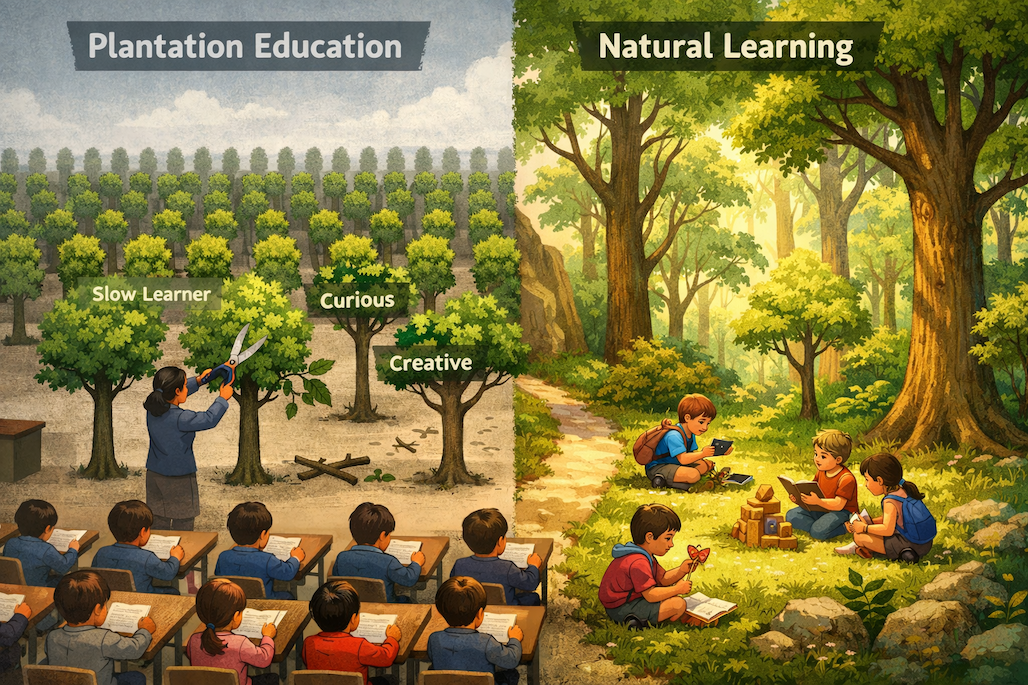
In many countries, the current education system requires a child to be sent to a school where they sit in a classroom with 50 or more peers.The setup is

  • One teacher to many students
  • Fixed curricula and schedules
  • Emphasis on exams, memorization, and compliance
  • Success measured mainly by test scores and certificates

While this model seems to work efficiently, it is seriously sub-optimal and a very lazy solution at best. It is reasonably efficient at producing uniform skills and managing young populations as they grow. The current education model  treats learners just like trees in a plantation, not a forest. The deliverables of the current education system are kind of:

“By age 10, every tree must be exactly 2 meters tall and perfectly straight.”

So the system basically:

  • Trims taller trees (discouraging excellence or curiosity)
  • Forces weaker trees to stretch unnaturally
  • Cuts off branches that don’t fit the template

The result?

  • Uniform appearance
  • Weaker trees
  • Lost potential

In this setup, the schools are “trimming” grounds for learners. Those who learn fast are told to wait, slow learners are labeled weak (some expelled), the curious and questioning ones are seen as disruptive, the creative and practical ones are marginalized while different learning styles are forced into one method.

I think the world must look for more optimal solution to educating children. No wonder many adults describe their school experience as routine rather than a transformative growth opportunity that shaped their current lives.

Loading