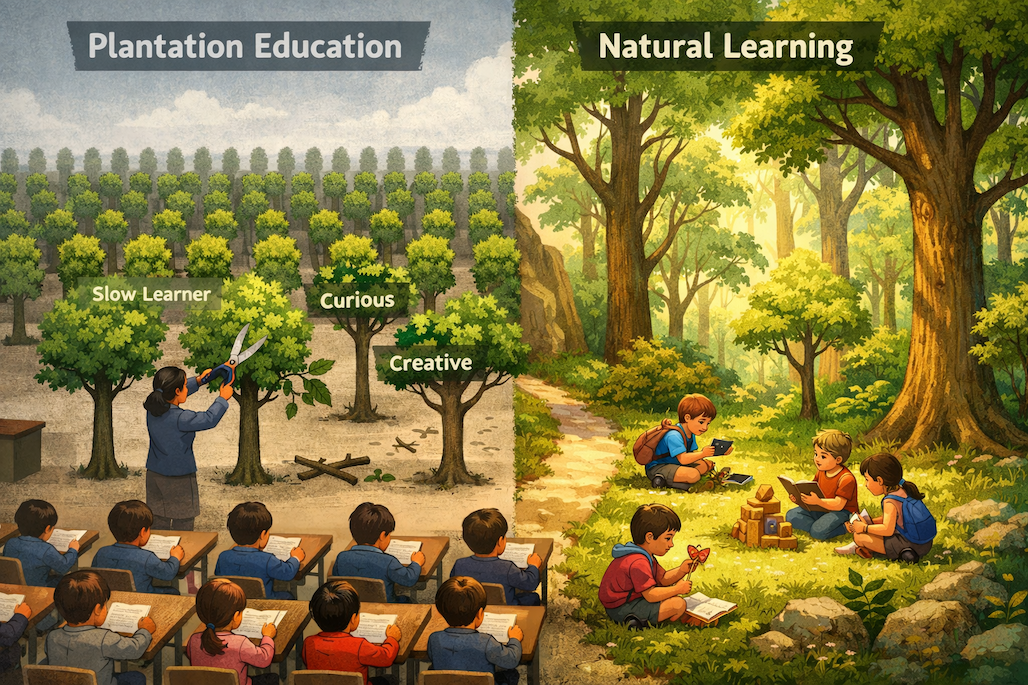
In many countries, the current education system requires a child to be sent to a school where they sit in a classroom with 50 or more peers.The setup is
One teacher to many students
Fixed curricula and schedules
Emphasis on exams, memorization, and compliance
Success measured mainly by test scores and certificates
While this model seems to work efficiently, it is seriously sub-optimal and a very lazy solution at best. It is reasonably efficient at producing uniform skills and managing young populations as they grow. The current education model treats learners just like trees in a plantation, not a forest. The deliverables of the current education system are kind of:
“By age 10, every tree must be exactly 2 meters tall and perfectly straight.”
So the system basically:
Trims taller trees (discouraging excellence or curiosity)
Forces weaker trees to stretch unnaturally
Cuts off branches that don’t fit the template
The result?
Uniform appearance
Weaker trees
Lost potential
In this setup, the schools are “trimming” grounds for learners. Those who learn fast are told to wait, slow learners are labeled weak (some expelled), the curious and questioning ones are seen as disruptive, the creative and practical ones are marginalized while different learning styles are forced into one method.
I think the world must look for more optimal solution to educating children. No wonder many adults describe their school experience as routine rather than a transformative growth opportunity that shaped their current lives.
For generations, education has largely positioned the learner as a passive receptor of information: listen carefully, take notes, memorize, reproduce. This model has produced capable graduates, but it has also left many learners behind—especially those whose pace, background, or learning style does not align with the “average student” the system quietly assumes.
Adaptive learning systems challenge this assumption at its core.
At their best, adaptive learning systems endeavor to transform the learner from a passive receptor of information into an active collaborator in the educational process. This shift is not merely technological; it is profoundly pedagogical.
Why the Passive Model No Longer Suffices
I have observed the same pattern across levels of education: when learners are treated as uniform recipients of content, engagement declines and misconceptions persist unnoticed. In mathematics education especially, gaps compound silently. A learner who fails to grasp place value in Primary Three will struggle with multiplication in Primary Five, and no amount of repetition at the higher level fully repairs the damage.
Traditional systems respond with more content, more drills, and more tests. Adaptive systems respond with better questions.
Adaptive Learning as a Partnership
True adaptive learning does not simply “personalize” content by adjusting difficulty. That is a necessary but insufficient step. The deeper transformation happens when the system continuously listens to the learner and responds meaningfully:
The learner’s errors are treated as data, not failure.
The learner’s pace becomes a design parameter, not a constraint.
The learner’s choices influence what happens next.
In this sense, the learner becomes a collaborator—co-constructing the learning pathway alongside the system.
In my work designing game-based learning platforms for early primary education, I have seen how even young learners respond positively when the system adapts with them rather than to them. When a child realizes, “The system noticed how I solved this,” motivation changes. Learning becomes a dialogue.
It is important that we do not design adaptive systems that merely optimize content delivery, the focus should be to cultivate learner agency. This means:
Allow learners to make meaningful choices.
Surface feedback that explains why a response matters.
Use adaptation to scaffold thinking, not to hide struggle.
In teacher training and curriculum design, adaptive tools should complement professional judgment, not replace it. The system provides fine-grained insights; the educator provides context, empathy, and purpose.
Implications for Education Systems in Emerging Contexts
In contexts such as Uganda and much of Sub-Saharan Africa—where classrooms are large and learner diversity is high—adaptive learning offers a rare opportunity. It can amplify the reach of skilled teachers by supporting differentiated instruction at scale. However, this potential will only be realized if adaptive systems are aligned with local curricula, cultural realities, and long-term educational goals.
While Technology alone does not transform education. Thoughtful integration does. The future of education is not one where learners are perfectly guided by algorithms, but one where learners are actively engaged in shaping their own learning journeys—with intelligent systems as partners.
When adaptive learning systems succeed, they do something quietly revolutionary: they return ownership of learning to the learner. And that, ultimately, is where meaningful education begins.
When people think of math, they often imagine endless equations and complicated formulas. For many, it feels like the hardest subject in school. But here’s the truth: math is not just about numbers—it’s the foundation of science, technology, and the future. If we want young people to thrive in a world powered by AI, robotics, medicine, engineering, and space exploration, we need to clear up the myths that hold learners back from embracing math.
Myth 1: Math is too difficult for most people. Fact: Math is a skill—and like any skill, it can be learned. Just as athletes train their bodies, scientists and innovators train their minds with math. With consistent practice, anyone can build the logical thinking needed to succeed in science and technology.
Myth 2: You have to be a genius to understand math. Fact: Genius is not required—practice is. Every invention we enjoy today, from smartphones to self-driving cars, is built on small steps of mathematical problem-solving. What makes innovators stand out is not “natural talent” but persistence and practice.
Myth 3: Science and technology are separate from math. Fact: Math is the backbone of innovation. Physics uses math to explain how the universe works. Biology relies on math to study genetics and ecosystems. Technology—from computer coding to artificial intelligence—is pure applied math in action. No math, no science. No math, no tech.
Myth 4: Failure in math means you can’t succeed in STEM. Fact: Failure is the fuel for discovery. Thomas Edison failed thousands of times before inventing the lightbulb. Every misstep in math, science, or coding is part of the journey. The more you practice, the more breakthroughs you unlock.
The Takeaway Math is not just another subject—it’s the gateway to science and technology. It builds the problem-solving skills that drive medicine, engineering, computing, and innovation. That’s why Boldungu exists: to make math fun, engaging, and accessible, so every learner can step into the future with confidence.
🚀 Want to be ready for tomorrow’s world of science and technology?
Technology can play a valuable role in enriching early mathematics education — not by replacing teachers or physical play, but by enhancing how children engage with concepts. When thoughtfully designed, digital tools can offer unique affordances that align with how young learners explore, imagine, and build understanding.
Here are four key ways well-designed educational technology can support playful, developmentally appropriate math learning:
Providing Interactive Visuals
Young learners often need concrete, visual representations of abstract ideas to make sense of math. Digital tools can bring these representations to life in ways that physical materials sometimes cannot. For example, an app might allow children to group and regroup counters, stretch a number line dynamically, or watch animations that show how shapes transform. These visuals do more than decorate the screen — they help children see how numbers behave, how patterns emerge, and how mathematical relationships work. Interactive visuals invite touch, play, and curiosity, turning abstract symbols into ideas children can grasp and explore.
Illustration of student using a mobile math learning application. Such apps including Boldungu among others.
Enabling Safe Experimentation
One of the key benefits of digital environments is that they allow children to try things out without fear of failure. When mistakes are met with encouragement, hints, or gentle corrections rather than penalties, children are more willing to take risks. This sense of safety is especially important in math, where the fear of being wrong can stop learning before it begins. In a well-designed app, learners can move pieces around, test strategies, or approach problems in different ways — knowing that nothing will break, and that every attempt is part of the learning process. This fosters a mindset of experimentation and resilience.
Adapting Challenges to Individual Needs
Every child learns at their own pace, and technology — when used wisely — can respond to this. Adaptive learning systems can adjust the level of difficulty based on a child’s performance, offering personalized support without labeling or pressure. A student who is struggling might receive extra scaffolding or simpler problems, while a child who finishes quickly may be presented with an added challenge or extension activity. This quiet personalization helps maintain engagement and ensures that every learner is working in their zone of development — not bored, not overwhelmed, but supported and stretched.
Integrating Rewards and Narratives That Sustain Motivation
Children are motivated by more than scores and stars. Stories, characters, progress journeys, and playful surprises can turn a math activity into an adventure. When digital tools integrate these elements with care — not as distractions, but as meaningful parts of the experience — they help sustain attention and emotional investment. A child might complete a math puzzle to help a character reach the finish line, or earn a badge for completing a number of challenges. These playful elements give children a sense of purpose, progress, and pride. They create a narrative around learning that is exciting and memorable.
A screen capture from the Boldungu mobile application
A Thoughtful Integration
Of course, not all screen time is equal. Technology should be used with intention — as part of a balanced, child-centered approach that also values movement, discussion, and hands-on exploration. But when grounded in sound educational principles, digital tools can amplify what children do best: play, explore, and learn through joyful challenge.
Today, educators and families have increasing access to learning apps that are informed by child development research and shaped by playful pedagogy. These tools don’t just deliver content — they create experiences that help children feel capable, curious, and connected as they grow in mathematical understanding.